
If you work in a lab, you know how essential Benchtop centrifuge are for separating samples quickly and accurately. Whether you’re handling blood in a clinical setting, isolating proteins in research, or ensuring quality in industry, these devices play a key role. But choosing the right model and using it effectively isn’t always straightforward. Understanding their applications can help you get the most out of your centrifuge.

What Benchtop Centrifuges Are and Why They Matter
While you mightn’t see them often, benchtop centrifuges play an essential role in many labs by quickly spinning samples to separate their components. You rely on these compact machines to isolate cells, proteins, or other materials without hassle. They save you time and effort, making complex processes feel straightforward.
Whether you’re working in clinical diagnostics, research, or industrial applications, benchtop centrifuges give you the freedom to handle samples efficiently and accurately https://laballiance.com.my/. Their small size means you don’t need bulky equipment taking up space, yet they deliver powerful performance.
How to Choose the Best Benchtop Centrifuge for Your Lab
Choosing the best benchtop centrifuge for your lab depends on several key factors that align with your specific needs.
First, consider the rotor type and capacity—make sure it fits your sample volumes and tube sizes.
Speed and force are vital; pick a centrifuge that achieves the rpm and g-force required for your protocols.
Look for user-friendly controls and safety features that give you confidence and ease during operation.
Portability and footprint matter if space is tight or you need flexibility.
Don’t forget maintenance and noise levels, so your workflow stays smooth and distraction-free.
Finally, set a budget but don’t compromise quality.
Benchtop Centrifuges in Clinical, Research, and Industrial Labs
Because benchtop centrifuges offer compact size and versatile functionality, they play an essential role across clinical, research, and industrial labs. You can easily separate blood components in clinical settings, speeding up diagnoses without sacrificing valuable bench space.
In research labs, they help you isolate cells, proteins, or nucleic acids quickly, giving you freedom to focus on experiments rather than waiting on equipment.
Industrial labs benefit too, using these centrifuges for quality control, product development, or sample preparation—handling diverse materials with precision.
Their portability means you’re not tied down to bulky machines, letting you adapt your workflow as needed.
Whether you’re running routine tests or complex analyses, benchtop centrifuges empower you to work efficiently, maintain accuracy, and keep your lab flexible to meet evolving demands.
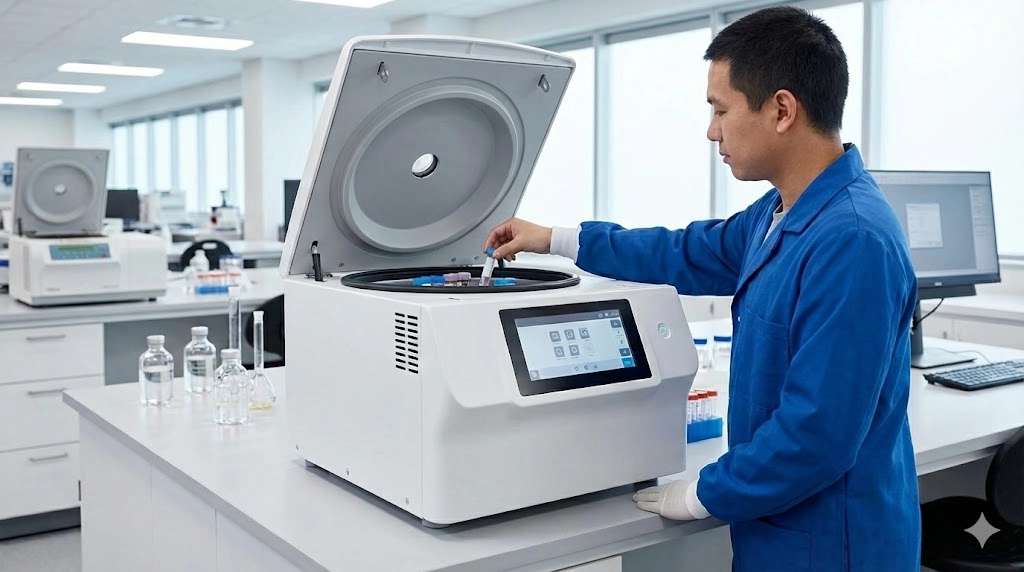
Tips to Maximize Benchtop Centrifuge Efficiency and Reliability
To get the most out of your benchtop centrifuge, you need to follow best practices that enhance both efficiency and reliability. Always balance your samples evenly to prevent unnecessary wear and maintain smooth operation.
Regularly clean and inspect rotors and buckets to avoid contamination and mechanical issues. Use the correct speed and time settings for your specific applications—over-spinning wastes energy and risks damage.
Keep a maintenance log to track service intervals and spot potential problems early. Don’t ignore manufacturer guidelines; they’re there to help you extend your centrifuge’s lifespan.
Common Challenges and Solutions When Using Benchtop Centrifuges
While benchtop centrifuges are essential tools in many labs, you’ll inevitably face challenges that can disrupt your workflow or affect results. Knowing how to tackle these problems lets you keep control and stay productive.
- Imbalance issues: Unbalanced tubes cause vibrations and noise. Always balance your samples precisely to avoid damage and interruptions.
- Overheating: Extended runs can heat the rotor, risking sample integrity. Use cooling features or take breaks to cool down.
- Rotor wear: Frequent use leads to rotor wear, risking failure. Regularly inspect and replace it before issues arise.
- Incorrect speed settings: Running at wrong speeds can ruin samples. Double-check protocols and centrifuge settings every time.
Facing these challenges head-on ensures your benchtop centrifuge serves you reliably, freeing you to focus on what matters most.
Conclusion
Benchtop centrifuges are essential tools that boost your lab’s efficiency across clinical, research, and industrial settings. By choosing the right model and using it correctly, you’ll get reliable, accurate results that support your work. Keep maintenance and troubleshooting in mind to avoid common issues and extend your centrifuge’s lifespan. With the right care, these versatile machines will continue helping you streamline sample preparation and improve your lab’s overall productivity.